Omnichannel
Omnichannel is a strategy that connects the channels an organization's customers use, from the website and mobile app to email, social media, customer service and stores, so that a customer can move from one channel to another without losing track of where they left off. It is also spelled omni-channel.
Definition and how it works
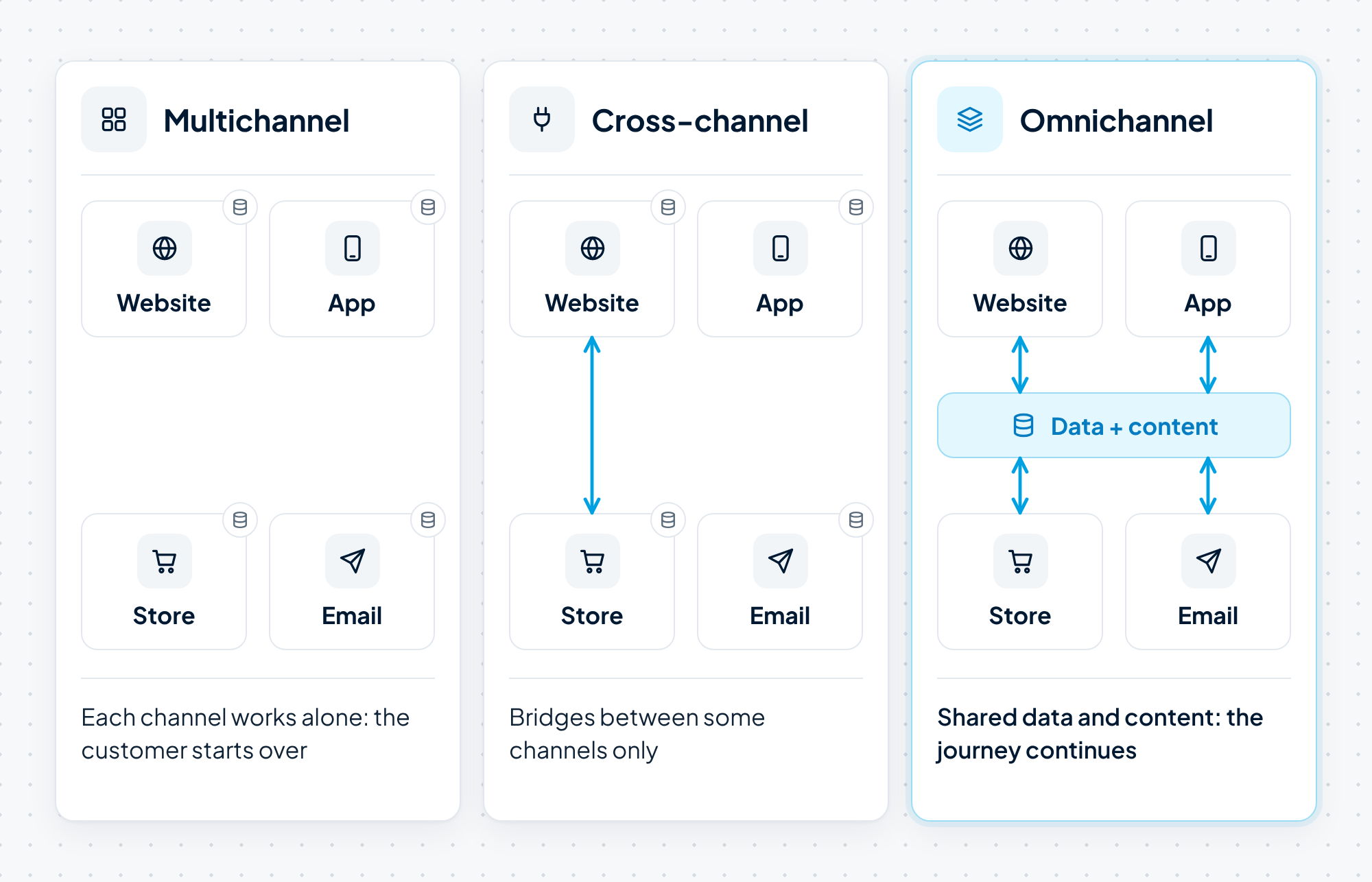
Omnichannel is often associated with retail, where a shopper can, for example, start a cart on their phone and finish the purchase in the store with that same cart, but it applies to any organization whose customers or users switch channels during the same task. Think of a policyholder who starts a claim in the app and finishes it with an agent, a B2B buyer who checks a product page on the website before ordering through a customer portal, or a resident who uses their phone to track a request filed in person at a government office.
For customers to move between channels without friction, each channel needs to know where they are in the process, which means the organization has to share customer data across its tools. Content also has to be consistent everywhere, so that product information and pricing terms do not change between channels. Teams have to work together as well, because when each team runs its own channel with its own targets, it rebuilds the silos between channels that shared tools were meant to remove.
Omnichannel, multichannel and cross-channel: the differences
Multichannel means being present on several channels that each run on their own, with their own content and their own data, so customers often have to start over when they switch channels. Cross-channel builds bridges between some channels, such as letting customers pick up an online order in the store, without all of them sharing the same information. Omnichannel goes further, since the connected channels draw on the same data and content, so the customer's journey continues from one channel to the next. The article Omnichannel CMS and tools for your strategy compares omnichannel and multichannel in more detail.
Omnichannel in practice
For content, omnichannel requires teams to structure information rather than format it page by page. When a product description or a news item is entered in the fields of a content type instead of being laid out for one specific page, the same content can feed the website, the app and other channels, each of which displays it in its own way. A correction made once then shows up everywhere. That is the principle behind content as a service, which spares teams from maintaining one version of the same text per channel.
To reach each channel, content travels in two ways: a website receives pages assembled by the CMS, while a mobile app or a chatbot queries the content through an API. A headless CMS delivers content only through an API, whereas a hybrid CMS combines pages and an API on top of the same content repository. The choice between the two depends on what the channels are, because headless makes sense when the channels consuming the content are not websites. With Jahia, contributors create and publish content either in a web CMS that assembles pages or through a headless approach, and the GraphQL API makes that content available to applications. The Omnichannel experiences page describes how Jahia is used across web, mobile and other channels.
The organization also has to apply the same rules across all its channels. Its content governance sets who can create, approve and publish content so that the message stays consistent, and on a multisite CMS the same governance covers every site and language.
Frequently asked questions
What is an example of an omnichannel journey?
An example of an omnichannel journey is a customer who compares two plans on the website, receives the one they saved in an email, and then completes the purchase with an advisor. The advisor can already see which plans were viewed, so the customer never has to repeat what they did on the previous channel, because the website, the email and the advisor's tools share the same customer data and content.
What is the difference between omnichannel and multichannel?
The difference between omnichannel and multichannel lies in how the channels are connected. In a multichannel approach, the organization is present on several channels that each keep their own content and data, whereas in an omnichannel approach those channels share the same customer data and content, so customers can pick up on one channel where they left off on another without starting over.
Do you need a headless CMS for an omnichannel strategy?
You do not need a headless CMS to run an omnichannel strategy. Headless makes sense when the channels consuming the content are not websites, such as a mobile app, a kiosk or a chatbot, whereas when the website is the main channel, a hybrid CMS, which assembles pages and also exposes content through an API, serves both the site and the other channels from a single content repository.
Does an omnichannel strategy have to cover every channel?
An omnichannel strategy does not have to cover every possible channel, because it connects the ones customers actually use. Connecting just the website, the app and email is enough to run an omnichannel strategy, provided those channels share the same data and content. Adding a channel without connecting it to the others, on the other hand, amounts to multichannel, with one more channel to maintain.