
What is a Digital Experience Platform (DXP)?
Romain GauthierUpdated on 10/10/2026
A digital experience platform (DXP) is an integrated set of technologies for creating, managing, personalizing and delivering digital experiences across websites, portals, apps and other touchpoints. A DXP platform builds on content management capabilities and adds data, personalization and integrations.
In brief
- A DXP has four components. They are content, data, integrations and presentation.
- The choice depends mainly on the need to unify content, data, personalization and channels.
- A composable approach assembles specialized components linked through APIs. A DXP can be delivered as one platform or as a suite of products.
- AI can assist repetitive content tasks such as drafting, translating and tagging. Keep a human validation step before publication.
What is the definition of a digital experience platform (DXP)?
A DXP lets organizations create and manage websites, portals, applications and other digital interfaces while adapting the experience to each user.
The need for DXPs has grown as businesses want to make better use of their customer data to deliver relevant digital experiences across channels.
By collecting and analyzing data, a DXP adapts content to each user's profile and behavior. On a corporate intranet, for example, an employee who often opens resources linked to a project or department can be shown related documents, training or news without searching for them. Visitors no longer all see the same interface. Each interaction can become more relevant.

Prefer to watch? The Jahia video What is a DXP? shows how content, customer data, personalization and integrations work together on one platform.
Consistent experiences across touchpoints
A DXP distributes content to commerce platforms, mobile apps, IoT devices, kiosks and other digital channels. Managing content once and publishing it to each channel keeps the experience consistent for the customer and supports an omnichannel strategy.
Personalization based on data
A DXP uses behavioral data to tailor experiences. Teams define rules that build audience segments from variables such as location, pages visited or device type. The platform then shows each segment the content that matches its profile.
Flexible integrations
A DXP connects to the rest of the application ecosystem, including ERP, product information management (PIM), marketing automation, CRM and other marketing tools. That flexibility lets teams assemble the technology stack they need.
How do a DXP and a CMS relate?
Content management is the core of a DXP, which usually adds layers such as a personalization engine and a customer data platform (CDP). It often works alongside marketing automation, CRM, digital asset management (DAM) and e-commerce tools, in a single offering or as a suite of products that work together.
For the full comparison, read a detailed comparison of a DXP and a CMS.
What are the components of a DXP?
A DXP combines four components, described here with their typical capabilities. The first three define what the platform can do. Presentation defines where and how it delivers.

Content
DXPs grew out of CMS technology, so they manage all sorts of content, from short texts to large files. They make it easy to create, edit and publish content and to deliver it through headless APIs and integrated search. They can also manage access for authenticated users at a granular level.
Typical content capabilities include the following.
- Omnichannel content
- Multisite management
- Enterprise search
- Authenticated experiences and access control
- Multilingual content management across many languages at once
- Content integrations
- Modularity and extensibility
Data
Data is one of the elements that sets a DXP apart from many other technologies. A DXP includes or integrates a customer data platform (CDP), an analytics engine and a personalization engine that uses the collected data to change the look and feel of the experience. If a visitor has come back to the same pages several times, for instance, the platform can show a banner with an offer or related products.
Data collection and governance matter as well, in particular compliance with privacy regulations such as the EU's GDPR.
Data capabilities usually cover these areas.
- Data governance (GDPR and other privacy rules)
- A 360-degree customer profile
- Reporting
- A/B testing and personalization
- Data integrations
Integrations
Integrations bring different systems together so that they make sense for their users. They range from simple front-end connections to complex back-end business logic. A DXP can be coupled with a PIM, a CRM, an enterprise resource planning (ERP) system or a complex e-commerce system. Its value depends on how smooth and quick those integrations are to implement. It should work with no-code platforms as well as with custom code on third-party APIs.
On the integration side, look for these capabilities.
- Out-of-the-box connectors
- Integration APIs
- Good samples and documentation
- Support for cloud deployment
- Support for automated testing
Presentation
A DXP delivers experiences through traditional HTML rendering with page templates, through API-first access for headless applications (Next.js, React, Angular, Vue and others) and through native mobile applications. Supporting all three matters because the needs of medium and large organizations differ.
Presentation capabilities include these.
- Omnichannel presentation (web, mobile, point of sale and more)
- Integration with headless front ends such as React or Angular
- Integration with CDNs and image optimization services
- Integration with SEO features
- High-performance delivery and front-end caching
- Integration with access control and authentication
- Cloud deployment
When do you need a DXP?
A CMS, like a DXP, can manage several sites, brands, countries and languages. A DXP is worth considering when the need goes further. Typical needs include the following.
- Building experiences that combine content, data and personalization.
- Using user data to understand and serve each visitor.
- Adapting journeys to profiles and segments.
- Coordinating experiences across web, mobile, kiosks and other touchpoints.
- Connecting the experience to CRM, PIM, ERP, DAM and e-commerce.
- Evolving the editorial process from end to end across teams and systems.
For a structured evaluation, see how to choose a DXP.
How do a DXP, a CMS and a composable approach compare?
A traditional CMS, a DXP and a composable approach differ in functional scope, coupling between components, responsibility for integration and maintenance of the architecture.
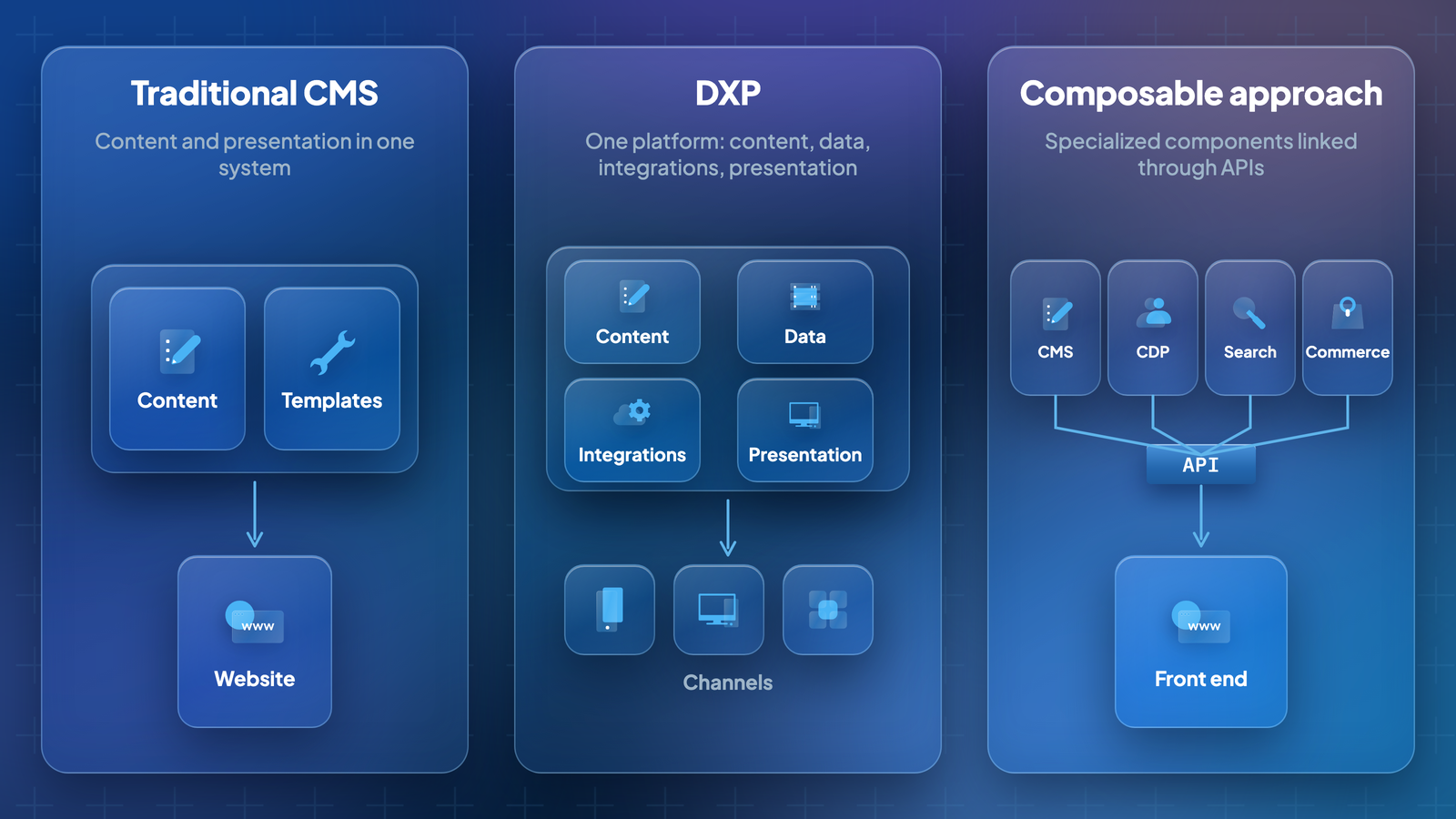
| Criteria | Traditional CMS | DXP | Composable approach |
|---|---|---|---|
| Functional scope | Content and presentation in one system | One platform covering content, data, integrations and presentation | Specialized components (CMS, CDP, search, commerce) linked through APIs |
| Coupling between components | Components belong to one system | Components belong to one platform or to a suite of products that work together | Components are modular and independently deployable |
| Responsibility for integration | Shared between the organization and its integrator, depending on the tools to connect | Shared between the platform vendor and the organization, depending on the scope and its connectors | Carried by the organization or its integrator across components, with each vendor for its own component |
| Maintenance and evolution | The vendor maintains the system and the organization maintains its project | The vendor maintains the platform and the organization maintains its project, product by product in a suite | Each vendor maintains its component and the organization or its integrator maintains the links |
A DXP can itself be assembled from components. What differs is who assembles and maintains the whole.
What does composable mean?
In this article, composable describes an architecture in which an organization selects specialized components and connects them through APIs.
According to the MACH Alliance, composable systems are modular and independently deployable, as opposed to tightly coupled ones.
Quick glossary of related terms
- Traditional CMS (also called WCM) delivers the pages of a website from the content it manages, with content and presentation handled together.
- Headless CMS manages content without a presentation layer and delivers it through APIs.
- Hybrid CMS offers both traditional and headless delivery.
- Composable approach assembles specialized components linked through APIs.
- Portal is a digital channel for logged-in visitors that delivers personalized engagement.
- Customer data platform (CDP) aggregates customer data to manage experiences.
- Personalization shows different content or experiences to different visitors or customers.
- A/B testing compares different approaches to find which performs better.
- No-code and low-code let business users perform tasks that used to require a developer.
- SPA (single-page application) and PWA (progressive web app) are applications built with front-end web technologies that consume headless content.
How does AI change a digital experience platform?
AI can assist repetitive content tasks such as drafting, translating, tagging and checking. People remain responsible for what goes live, so a validation step before publication matters as much as the AI itself.
Content assisted by AI generally goes through drafting, checks, human validation and publication.

- Content production. AI assistants can help draft and rewrite texts, translate pages, adapt them to an audience and suggest metadata. Editors review each result.
- Governance. Quality checks on accessibility and readability can run before publication. A human validation step before publication is good practice.
- Data use. AI can help build audience segments, improve search and tailor journeys, provided the underlying data is well governed and users have consented to its use.
What can marketing teams do with a DXP?
With a DXP, marketers create, manage and deliver websites, mobile experiences and campaigns and can act on them without waiting for a development cycle. Typical tasks include the following.
- Create responsive landing pages often without developers or HTML knowledge, using templates that leave room for creativity and testing.
- Manage websites in many languages with tools that keep the process consistent for global brands.
- Mix anonymous and authenticated experiences, since the digital experience continues beyond the first visit.
- Reuse content across sites, portals and applications, which reduces outdated duplicates.
- Manage content from external sources such as a PIM, an enterprise content management system or custom software as native editorial content, then add it to a page, choose how it is displayed or link it to editorial content.
- Create and manage forms with little or no development and push the data to a CRM or to marketing automation, so that adding a form field also adds the data to the rest of the marketing and sales stack.
- A/B test headlines and any other content or page.
- Personalize content in a portal with customer data collected on the website, as part of a lasting personalization practice.
What can developers do with a DXP?
For developers, a DXP can simplify the setup of new sites and the work on back-office management. Implemented well, it can reduce technical issues and leave more time for projects that move the business forward. It also gives developers, marketers and designers a common platform to build and manage digital experiences.
A well-designed DXP should provide the infrastructure for fast page loads. Analytics, automation and security should be built in or easy to set up alongside it. It should also help developers follow in-house security policies, reuse their code and deploy easily. Common tasks include the following.
- Launch websites while keeping brand guidelines, using page and site templates that can be reused from one project to the next.
- Explore and extend APIs with GraphQL or REST and implement custom logic and services, with the DXP as a central access point that simplifies authentication, access control and deployment. GraphQL is self-documenting, which helps developers understand an API.
- Combine traditional and headless delivery with the front-end technology of their choice on the same platform and reuse assets from one front end to another.
- Use customer data to build custom experiences such as quizzes, funnels and assessments.
- Extend user interfaces to add capabilities that can be reused between projects and make features global or site-specific.
- Aggregate content sources (a PIM or any API), provide federated search (one search across several sources) and integrate with CRM, analytics tools and marketing automation platforms.
- Develop in modules and hot deploy changes to test them. Modules can cover anything from integrations with external content to extensions of the user interface.
DXP, marketing stack and digital experience stack: what is the difference?
A DXP is one platform within a stack that connects the other tools. In this article a DXP means a platform that combines content, data and integrations.
What is a marketing stack?
A marketing stack is the collection of software tools a business uses to plan, execute and measure its marketing, for example email marketing, social media management, content creation and advertising. It can include paid and free tools and is customized to the needs of each business.
What is a digital experience stack?
A digital experience stack is the collection of software tools a business uses to create and manage its customers' digital experiences, such as websites, mobile apps and online services. It typically covers web design and development tools, content management, e-commerce and customer relationship management. Its aim is to deliver engaging, personalized experiences across all digital channels throughout the customer lifecycle, from first contact to post-sale.
How does a DXP differ from a stack?
A DXP is part of a digital experience or marketing stack. These stacks can be much more complex and contain many interconnected services. A DXP provides a platform that helps connect all the touchpoints with the various elements of the stack.
How does a DXP fit in your stack?
A DXP brings together tools and technologies from the stack to create and manage digital experiences, which can streamline workflows, reduce complexity and keep experiences consistent.
How did DXPs emerge?
DXPs grew out of web content management and portal software, with data added later.

- DXP vendors started as web content management (WCM) or portal software vendors.
- They then extended their offer toward a horizontal portal.
- Data came later, as a further area of investment.
An equation helps remember what a DXP combines. The visual shows the first three terms. Presentation completes the four components.
DXP = Content + Data + Integrations + Presentation
What is the Jahia DXP?
Jahia helps enterprises create and manage websites and portals at scale. Its DXP brings together a CMS, a customer data platform (CDP), integrations and presentation.

- A CMS available in a traditional and in a headless architecture, so it works as a hybrid CMS and each organization chooses the mode that fits.
- 1000+ connectors with stackConnect to link the platform to the other tools of the organization.
- An open architecture, where the core of Jahia is open source.
- Personalization and A/B testing to tailor content to each audience.
- A customer data platform (CDP) that works alongside the CMS.
What can teams build with Jahia?
These organizations run their sites and portals on Jahia.
- RTE runs a personalized service portal with three user types (anonymous visitors, logged-in users and clients) and editorial autonomy for business teams.
- Arkema manages nearly 90 websites, with content shared across sites and languages managed by each business unit.
- Ben & Jerry's has 10 apps integrated into its DXP stack, powered by Jahia, for a consistent brand across its global websites.
How does Jahia use AI?
Jahia offers AI modules for assisted translation and automatic tagging, plus a page quality audit with AI as an option. Jahia's AI workflows keep a human validation step before publication or go-live.
Questions about digital experience platforms? Contact the Jahia team.
Frequently asked questions
What does DXP stand for?
What is a DXP used for?
What role do APIs play in a DXP?
How does a DXP handle developer flexibility and marketing team independence?
How does a DXP integrate with existing backend systems like e-commerce, ERP and DAM?
How do DXPs support localization and multisite delivery?
How do marketing teams use a DXP?
Discover
Related resources
 Blog
BlogOpen Source DXP: What It Is and How to Choose One
What an open source DXP is, how open source, open core and proprietary licences differ, what each layer of a DXP can open, and the criteria to choose one.
 Blog
BlogMulti-site CMS for insurance: from service portal to performance portal
A customer portal that answers requests can, once connected to the CRM, become a lever for the relationship. What a multi-site CMS for insurance must do to get there and how to choose one.
 Blog
BlogSite factory: definition and 5 steps to build one
What a site factory is, how it differs from a multisite setup, its benefits, how to choose the right technology and the 5 steps to build and run your own.
 Blog
BlogTop 8 Liferay alternatives in 2026
The main Liferay alternatives are Jahia, Adobe Experience Manager, Sitecore, Magnolia, Kentico, Progress Sitefinity, Drupal and Joomla. They differ on licensing model, technical stack and what they can run as an enterprise portal.
 Blog
BlogStatic vs dynamic websites: SSG, SSR and what to choose
Static vs dynamic websites, against the MDN and AWS definitions: how each one is built, how to tell them apart, and where SSG, SSR, ISR and CSR fit in.
 Blog
BlogWhat is a Web Portal? Definition, examples & enterprise Use Cases
From the Intranet to the extranet, the web portal has established itself as a leading online tool for companies in all sectors. But it’s not always easy to define exactly what this term means.
 Whitepaper
Seizing the Digital Experience Opportunity: why the Marketing–IT partnership is crucial
Learn how aligning marketing and IT around data, processes and technology helps organizations accelerate digital experience value while reducing risk.
 Webinar
How does your CMS fit in your digital experience stack
This webinar explores how a CMS or DXP fits into your digital experience stack and how to evaluate martech integrations beyond simple connectors.
 Webinar
Turn your CMS into a DXP
Learn how to evolve from a CMS to a DXP by unifying content and customer data to enable omnichannel personalization and scalable digital experiences.