
90
Sites centralized by Arkema
With a multisite CMS, every site can keep its own look, content, and editorial flexibility while teams share one platform, reusable building blocks, and consistent governance. Central control where it matters, local freedom where it counts.
Sites centralized by Arkema
Country sites run by Ben & Jerry's

Sites for the European Parliament
Large groups already run a sprawling web presence: many sites across countries, brands, and business units, often on a patchwork of different tools and teams. At that scale, four problems pile up.

Dozens of sites across countries, brands, and business units, often split across different tools, teams, and standards.

Each team builds its own habits and components, and duplicated content goes out of date the moment one copy is updated.

Every extra CMS is one more system to secure and patch, and hundreds of accounts spread across tools are hard to keep under control.

Each new site repeats install, configuration, and integration, and every update has to be deployed site by site.
Reuse without uniformity, build the common parts once, reuse them everywhere, and let each site keep its own identity.

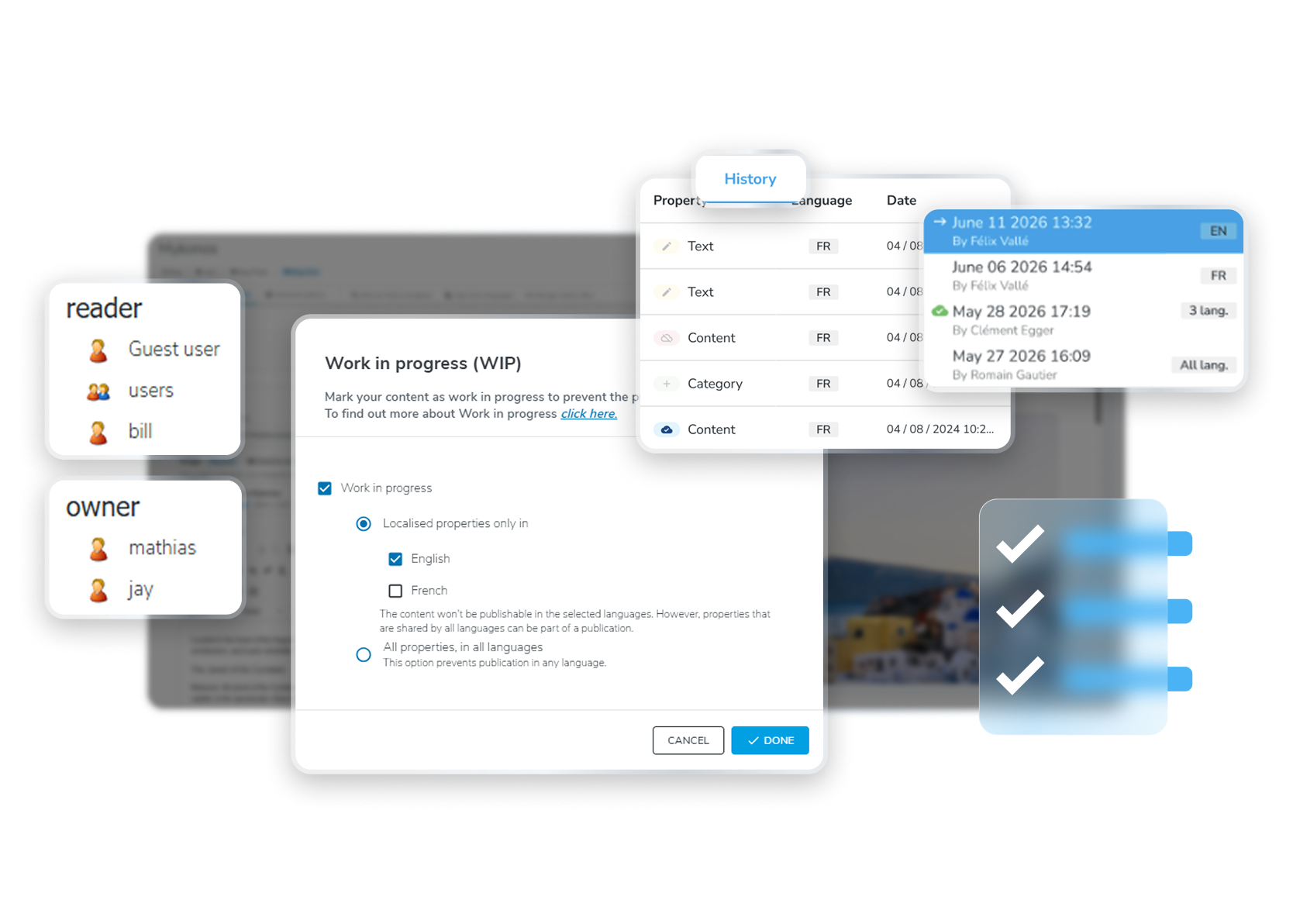
Sharing a foundation only helps if each team can still move on its own. Too much control slows everyone down; too much freedom breaks consistency. Jahia's roles and permissions give you that governance without the bottleneck.
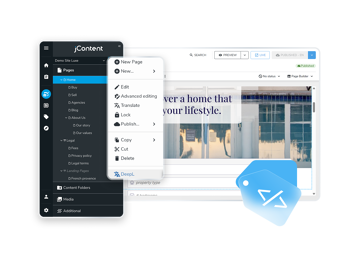
Duplicated content is how inconsistency creeps in: update one site, the others go stale. Jahia is content-based, so content is made to be reused within and across sites.
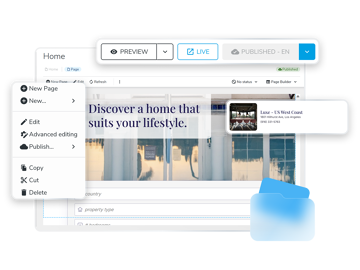
Reuse pays off most when you launch a whole new site. Jahia makes site creation repeatable, so a new brand, market, or campaign site goes live far faster.
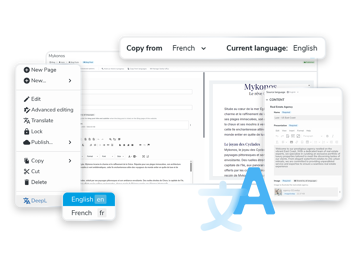
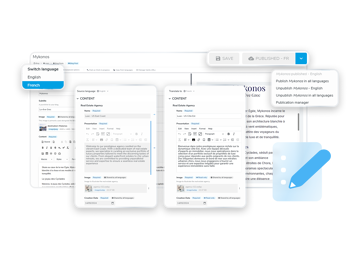
New sites rarely stay in one language. Going global is more than translation: each market has its own catalogs, journeys, and cultural details. Jahia reuses content and keeps every language version linked.
AI helps local teams produce more content, faster. It is a help, not a replacement: it drafts variations by market, tone, or format in seconds, and the local team that owns the site reviews and approves them.
Draft and reshape content for each market, brand, tone, or format, so teams start from a first version instead of a blank page. The local team reviews and approves before anything goes live.
Translate pages into many languages automatically, so a site reaches every market without being rebuilt by hand. Local teams keep the final say on sensitive content.
With Jahia's MCP server, an AI assistant acts on your content directly: create a page, update a block, or reorganize a section across sites from a plain-language request.
Content spread across many sites is also what AI models read about you. Well-structured content and clear rules keep you in control of how your brand shows up, on your sites and in AI answers.
With a multisite CMS in place, one platform handles very different situations.
Corporate sites, product and campaign sites, event pages, internal or CSR mini-sites: each has its own goal. Run them side by side in one environment and reuse templates so every new site is quick to launch.
Your setup is more than public sites: it also includes portals and apps that manage content. Keep them consistent, so people move from one to the next without logging in again or hitting a different design.
Give each market its own languages, catalogs, customer paths, and local rules, from payment methods to date formats. Reuse a shared base and adapt each country site instead of rebuilding it, with international SEO handled along the way.

Give each brand its own site and identity, and share components only where it helps. Keep the common building blocks in one place, and let a dedicated team run each brand within the group's framework.
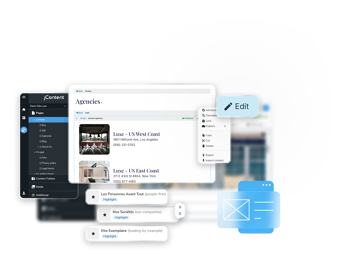
From a single custom page to a full mini-site, give every agency or franchise a local presence within a shared framework. Each manages its own details, opening hours, team, local offers, at the scale of hundreds or thousands of locations.

Arkema faced exactly this challenge: a global network of sites, brands, countries, and projects. On Jahia it brought everything under central control while keeping local teams independent. Each site keeps its own webmaster, teams share best practices and content through a common hub, and managing many languages is far simpler across the group.
At some point you have to choose: run everything on one platform, or keep a separate CMS for each project. There is no single right answer; it depends on your structure, maturity, and priorities. Here is how the two compare.
| Criterion | Multisite CMS | Separate CMSs |
|---|---|---|
| Maintenance cost | Lower overall: infrastructure, updates, and security in one place | Spread out, and usually higher at scale |
| Time to publish | Fast, with reusable templates and processes | Longer: each site built and configured on its own |
| Local autonomy | Freedom within central rules | High: each team picks its own CMS, design, content |
| Brand and UX consistency | High: shared templates, components, style guide | Brand can drift without central rules |
| Scalability | Grows with the organization: sites, languages, channels | Possible, but harder to organize long term |
| Security and compliance | Consistent rules and protocols, easier to audit | Varies locally, harder to audit globally |
| Global visibility | Unified view of performance and usage | Fragmented, hard to aggregate |
Run every site, brand, and market on one platform: consistent where it matters, independent where it counts, and cheaper to run than a separate CMS for every project. Your teams spend their time on content, campaigns, and markets, not on maintaining a dozen separate systems.
Our experts help you define the right platform, hosting, and infrastructure tier for your needs

A multisite CMS is a single platform that manages many websites at once. Teams share the same base of components, templates and rules, while each site keeps its own domain, theme, content, permissions and languages.
With a multisite CMS, infrastructure, updates and security are centralized, which lowers costs and speeds up time to launch. With one CMS per project, each team runs its own tool: more autonomy, but brand consistency and security are harder to keep at scale.
Yes. Each site keeps its own domain, design, content, languages and settings. You share the common building blocks (templates, modules, connectors) and freely adapt the look and content of every site.
Jahia roles and permissions give you central control with local autonomy. You define predefined or custom roles, assign a local administrator per site, and set rights by site, section, page or content type, down to read-only or translation-only access.
The language versions of a page stay linked and reuse the same layout and assets, so you do not rebuild pages market by market. Translation can be automated through native connectors, while local teams keep control over sensitive content.
You start from a template set, a pre-packaged site (home page, legal notice, FAQ) or an import of an existing site. Preconfigured templates, rights and settings apply instantly, so teams can focus on content and design.
Jahia is content-oriented: a single version of a piece of content can be published across several sites through 'paste with reference'. You update it once and every site follows, which avoids the duplicate content that hurts SEO.