
How I used AI to develop a Jahia module in JavaScript in record time
Stéphane Monier
Accelerate front-end development on Jahia with AI, drawing inspiration from existing projects
Since version 8.2, Jahia has opened up an exciting new avenue for front-end developers: the ability to create modules entirely in JavaScript (TypeScript/React). This major development means that you no longer need to be a Java expert to build rich, integrated experiences on the platform.
Jahia's philosophy is clever: rendering is mainly done on the server side (Server-Side Rendering) using JavaScript helpers to access the Jahia context and JCR (content repository) data. Then, thanks to a selective hydration mechanism called “Island Architecture,” components can become interactive on the client side. This gives developers complete freedom to enrich their front-end while maintaining optimal performance.
The starting point: the reference project ‘jahia-luxe-demo’
To demonstrate the power of this new approach, the Jahia teams have made a comprehensive reference site available: ‘Jahia-luxe-demo’. This project — available on GitHub (https://github.com/Jahia/luxe-jahia-demo) — simulates a luxury real estate listing site. It is a gold mine for understanding best practices in JavaScript development on Jahia.
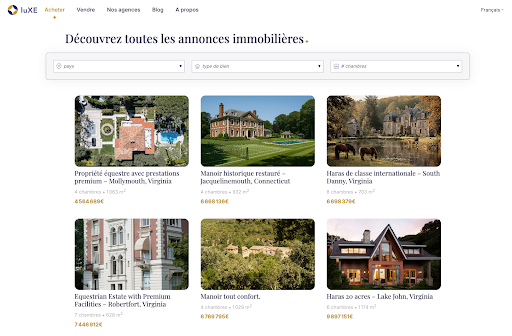
Inspired by this demo, I set myself a challenge: to use AI coding tools to recreate a similar front-end, but for private classified ads. The basic mechanism (display, search, filters) is very similar, but the types of content are completely different.
Context is king: giving AI the keys to the kingdom
One of the most important factors for success when working with AI to generate code is its ability to understand the full context of the application. In my case, this meant two things:
1. The AI needed access to the entire source code of my new application, which I named ‘ClassifiedAds’.
2. More importantly, it had to be able to actively draw inspiration from the ‘Jahia-luxe-demo’ code.
To do this, I set up a simple but effective local development environment with VSCode:
* I cloned the ‘Jahia-luxe-demo’ repository.
* At the same level in my file tree, I created the project for my ‘ClassifiedAds’ module.
This structure allowed the AI assistant (in my case, a Codex/Copilot-type tool) to “see” and analyze both projects simultaneously.
To start a Jahia JavaScript module, follow the tutorial: https://academy.jahia.com/tutorials-get-started/front-end-developer/introduction
Step one: define the content model with AI
The first task was to ask the AI to generate the definition for my ‘ClassifiedAd’ content type (a classified ad). To guide its creativity, I asked it to draw inspiration from the well-known schema.org standard. In a matter of seconds, I had a structured and relevant content definition, ready to be integrated into Jahia.
The reactor core: replicating the search and display logic
The main challenge was to reproduce the faceted search functionality found in Jahia-luxe-demo. In this project, the components that interested me most were:
* ‘Estate’: The detailed view of a property.
* ‘SearchEstate’: The search component that executes a GraphQL query with filters to refine the results.
I then used a very direct prompt in my editor, specifying the local paths of the files to be analyzed:
> “Explore ‘../jahia-luxe-demo/packages/template-set/src/components/Estate’ and ‘SearchEstate’. Take inspiration from them and apply the same logic to my ‘ClassifiedAds’ component. Consider the following properties as search facets: ‘category’, ‘condition’, ‘type’, ‘availability,’ and ‘price.’”

The result was spectacular. The AI:
1. Analyzed the structure of the React components in the demo.
2. Understood how the GraphQL query was dynamically constructed from the selected filters.
3. Generated a new ‘SearchClassifiedAds’ component and associated views (server and client), adapting the logic to the new facets I had provided.
The foundation of my application was now solid, (https://github.com/smonier/classifiedads) directly modeled on the reference implementation provided by Jahia experts.

Conclusion: a new era of productivity
This experiment demonstrates a paradigm shift. By providing AI with rich and relevant context (in this case, a high-quality reference project), it is possible to go beyond simply generating code snippets to assemble complex features in record time.
The role of the developer is evolving: they are becoming architects who guide AI, validate its proposals, and iterate quickly to refine the final product. For development on platforms such as Jahia, this approach is incredibly powerful. It allows developers to quickly adopt best practices and focus on adding business value rather than rewriting complex logic.
Discover
Related resources
 Blog
BlogMigrate from Adobe AEM to Jahia: the 5 Steps of a Free AI-Powered Migration
Free assessment, AI-powered rebuild, validation, redirects and go-live: the 5 steps to migrate from Adobe AEM to Jahia in 1 to 3 months, run by Jahia experts.
 Blog
BlogEU AI Act labelling requirements: when to label AI-generated content and how to do it in Jahia
EU AI Act Article 50: when AI-generated text must be labelled, what the editorial control exception requires and how to set it up in Jahia, step by step.
 Blog
BlogAI Overviews: is your CMS ready for generative search?
Google says AI Overviews need no special optimization. What your CMS actually changes is your ability to hold SEO fundamentals across thousands of pages.
 Blog
BlogFree AI-Powered CMS migration: Migrate your website fast
Migrate your site to Jahia for free with AI: see the result before you commit, sovereign hosting, and save up to 50% on your annual subscription.
What is an AI CMS? How to choose one for AI workflows
Compare AI CMS platforms for governed AI workflows: how AI-native design keeps marketers and IT in control, plus 5 criteria to choose the right one.
 Blog
BlogAgentic AI in content management: What your CMS needs in 2026
Agentic AI explained: definition, how it differs from generative AI, content management use cases, and why the CMS governs AI workflows.
 Whitepaper
Integrating AI into your CMS in 2025?
This whitepaper explores how to integrate AI into your CMS in 2025 to optimize content management, user experience and digital performance.
 Webinar
Personalized Experiences: Crawl, Walk, Run
Learn how to build effective personalization strategies step by step to boost engagement and conversions without analysis paralysis.
 Blog
BlogAI: what you need to know before setting up a PoC
So we went along to the Gartner Symposium, to get the analyst's latest technology recommendations. The topic at the heart of the debate? AI.